Thursday, May 17, 2018

Remote Alaskan Radar Is America's First Line of Defense


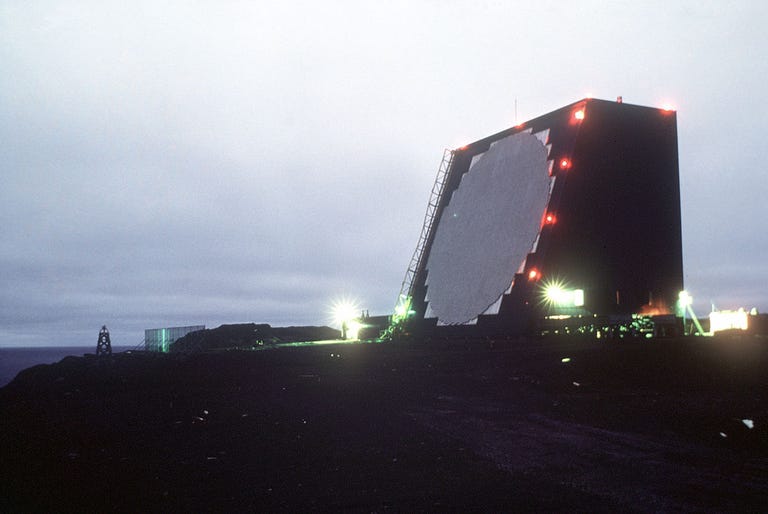
In a freezing, remote island off the coast of Alaska, Eareckson Air Station. This radar is permantly facing west, and is America's first warning system against incoming missles. In today's day tensions between world powers is high, so America's warning system is top notch. The radar itself is 120 ft tall with a radar array that spans 94.5 ft across. The main component of the radar is a L-Band phased array radar that operates in 1175-1375 MHz ranges. This extremely complicated radar consists of 34,768 elements, including 15,360 active radiating elements, set in a pattern that enables a 136 degree radar coverage. It can also track up to 120 targets and maintain precise tracking data on 20 of them. Not only does this machine have a tactical purpose, NASA can use it to do detect satellites and "space-junk" that could possibly pose a threat to spaceflights. 


New Traffic Light Prediction App


Connected Signals created an app that tells drivers when green lights will turn yellow and then tells them when they will turn red. The app will also tell drivers who are stopped at a red light when the light will turn green and makes a bell noise 5 seconds before a red light turns green to help the driver prepare to go. The app will also tell drivers if they need to speedup or stay at their current speed in order to make the light. Connected Signals works with municipalities to securely collect current and accurate signal data. The gathered data is combined with GPS, map, and speed limit information, and then used to predict upcoming traffic light behavior with proprietary analytics and algorithms. The app has been proven to make driving safer and reduces the stress and road rage of its users. Also sending recommended speeds and signal countdowns straight to drivers could cut down on fuel consumption which would save everyone money. Because the app came out so recently it is only available in a few US cities that have recently updated traffic light systems such as San Jose. I think the app will become as popular if not more popular than Waze within the next 5 years and will become usable nation wide.


Hydro Bikeeeeeee


Riding the Waves 
Dasanie Pena

          In 2011, the idea of a aquatic surfing bicycle was brought up by Guy Howard-Willis. Following 7 years of experimenting and research, the Hydrofoiler XE-1 was made. This design is a mix of a bicycle, surfboard, and hydro foil. 
Here is a video!!!

     The two partners of the invention are Guy Howard-Willis and Roland Alonzo (photographed below). The two partners call their invention a hydrofoiler bike watercraft. The design resembles a standstill stationary bike found at gyms. This invention is lighter than a water scooter. The bike cruises on water with the use of a pedal and a 400 W e-bike motor. If the bike is not in motion, it can submerge itself a few feet without sinking. This way it may be restarted without having to bring the bike to shore. 

Image result for Guy Howard-Willis and Roland Alonzo

 “When I ride the Hydrofoiler, I can draw similarities to riding my road bikes. The issue was around man’s ability on water, we have so many great watercraft out there, I wanted to push the envelope on what could be done for bicycle and water enthusiasts,” Howard- Willis said.

The Hydrofoiler XE-1 costs about $5,500. 
Image result for Hydrofoiler XE-1


Wednesday, May 16, 2018

Machine Muscle

MACHINE MUSCLE
ALEXANDER PEDRO


             Machine muscle or "soft robots" are a new way that engineers are creating machines. The way these muscles works is very simple and very cheap. A team from the University of Colorado Boulder have proven this doesn’t need to be expensive; their brand new artificial muscle is a steal at 10 cents per device. The “muscle” works by applying a small voltage across hydrogel electrodes on either side liquid insulators pouches (these pouches can be filled with something as basic as canola oil).


The voltage creates an attraction between the two electrodes and pulls them together; displacing the liquid which in turn changes of shape of the pouch allowing it to push or pull levers, arms or any other articulated component. It is suited to carry out a variety of tasks – from picking up delicate objects to lifting heavy objects. In fact, the team claims the robot will be able to lift objects up to two-hundred times its own weight.

3D reconstruction of plant structures using AI

3D reconstruction from images of different angles has been thoughroughly studied. However, it was difficult to reconstruct the parts of objects which have hidden portions, such as plants with branches hidden under their leaves.


By combining the original image-to-image approach in a Bayesian deep learning framework and 3D reconstruction, a group of researchers led by Fumio Okura were able to estimate the location of branches that are hidden under leaves in images. Using these estimated branch positions, they achieved 3D reconstruction of plant structure.

The results are incredibly important for cultivation and management of plants by artificial intelligence. They will be greatly helpful for future cultivation technology as it allows for detailed management of growing plants in places where cultivators' can't see, coming up with best trimming or pruning methods for plants, and predicting future growth of plants.

https://www.sciencedaily.com/releases/2018/05/180507090257.htm

Monday, May 14, 2018

Advancements for ASL

ASL (American Sign Language) has recently seen a possible advancement for communication. A team at Georgia Institute of Technology has utilized acoustic chirps to recognize hand movements. "Chirp systems emit a 'swept'-frequency signal, meaning that the transmitted signal is emitted over a period of time and over a set range of frequencies" (woodshole). The image below gives a visual interpretation of this system.


The team at Georgia tech call this system FingerPing, which is composed of a thumb & wrist piece. In the ring (thumb piece), there is a speaker and the Receiver 1. In the wrist, there are the other three receivers. This system differs from other attempts at advancing ASL by using a small system for the user to wear instead of "cameras...that can be obtrusive and is unlikely to be carried everywhere" (Mitchell).  The image below shows multiple diagrams of the intricacies of the system.

Mitchell later in the article goes on to explain the way the system works, which is when "the ring produces acoustic chirps that travel through the hand and are picked up by receivers on the watch. There are specific patterns in which sound waves travel through structure including the hand, that can be altered by the manner in which the hand is posed. Utilizing those poses, the wearer can achieve up to 22 pre-programmed commands" (Mitchell).

A similar concept was explored in 2017 by students from University of Antwerp in Belgium. They focused on the issues with limited interpreters for the deaf and chose to try solving the problem with a "3D-printed robotic arm that can perform sign language" (Owano). 3D-printing has already been used for specific car parts and even bones for a patient needing a transplant. With the success and curiosity of 3D-printing, the students chose to use it as a method of treating the problem with communication.


As shown above, the model created by the students was "designed and built over three years, the arm can form the gestures that make up the letters and numbers of basic sign language." (Westlake). "When the user types text into the software, the robotic hand translates the text into sign language" (3ders.org).

Both articles from 2017 & 2018 deal with the issues of interpretation in ASL. Even though they are attempting to solve the same problem, they go about the process in different ways. It is interesting that in the span of one year there were two articles from across the world, and possibly more, that dealt with such a specific topic. The articles not only show resolutions to the issue, but reveal how there's more than one way to attempt to solve a problem.

Trial and error is essential in engineering because everything can be adjusted, and even though a product may seem "perfect," there are more ways to alter the design. It is important as engineers to always be questioning the problems in the world that need to be fixed and brainstorming methods to solve them. With such a serious topic as interpretation in ASL, it is important to have teams of engineers actively using advancements in technology to find a resolution. The teams in Georgia and Belgium prove that while a product is good, there are ways to improve upon the design and those improvements need to be considered for a positive progression of society

Sources:
David Mitchell
woodshole
Nancy Owano
Adam Westlake from SlashGear
3ders.org
Destiny Gwann- Blog

New plant tests energy-saving way to treat wastewater


By: Destiny Gwann 


            There are different ways to try and clear up the wastewar that is used on a daily. Water that has been used in the home, in a business, or as part of an industrial process. With that being said California Energy Commission gave two guys of the names Craig Criddle and Bill Mitch a $2 million grant that has ancient microorganism to try and work in the largest demonstration of a cheaper wastewater treatment process.  What they are doing is called the "anaerobic bacteria" and they have plant treatments in South Korea and Stanford campus.The group has broken ground on the demonstration plant, which is slated to come on line in fall 2018. It will eventually process 20,000 gallons of wastewater per day to provide validation and operating experience for what could become a full-scale plant capable of processing millions of gallons of wastewater per day. Aerobic vs. Anaerobic. Aerobic bacteria had to rely on oxygen to survive. Since they switched to anaerobic bacteria the cost went down a lot more then what they thought it would be said by Sebastien Tilmans who is the civil engineer who runs the Codiga Resource Recovery Center on the Stanford campus. In the end the outcome will be a lot better. They believe that in addition to saving space and money, the Stanford researchers said that their anaerobic process has yet another benefit which is the ability to digest pharmaceutical drugs and powerful household and industrial herbicides that have proven difficult for standard aerobic bacteria to digest.