Friday, May 4, 2018

Hibernating Animals are the Answer to Medical Advances


Hibernating animals might be the answer to aid in medical advances. Hibernating animals lower their core body temperature to near freezing. This also drops its heart rate dramatically.

Scientists are now figuring out how the cells of hibernating animals adapt to cold temperatures may help scientists extend the storage life of donated human organs that are awaiting transplantation, the researchers said in a new study.

One day this research could help improve induced hypothermia therapy. This is when a person's body temperature is lowered after a cardiac arrest or brain injury. This therapy can help protect the brain in such patients but could also have side effects from the cold- induced cellular damage. 

Researchers found a ground squirrel that lives in central North America. This squirrel dramatically lowers its body temperature to just above freezing, and slows its heart from 200 beats per minute to only 20.


When studying this animal, researchers found a cellular structure called the "microtubule cytoskeleton" . This is a network of small tubes that provides structural support to a cell and is vulnerable to the cold. When they compared the ground squirrels cells to human cells, they found that the "microtubule cytoskeleton" remains intact during the cold in the squirrels but deteriorates in human cells.

https://www.livescience.com/62483-hibernating-squirrels-medicine.html

Thursday, May 3, 2018

The New Wave of Wifi

Wifi has improved people's lives whether it is for teaching, learning, or for leisure, it has proved to be essential for many people. With all of these people using wifi, it was only a matter of time until there wasn't enough bandwidth Articles from the Harvard John A. Paulson School of Engineering and Applied Science explain this issue in great detail. Both articles discuss using terahertz frequencies as a way to transmit information in communications because the frequencies "could move hundred's of times faster than today's wireless" (phys.org).


Terahertz is a unit of frequency (10^12 hertz). As shown in the image above, terahertz waves are in between radio waves and light. Terahertz frequency isn't as fast as x-rays, but is much faster than microwaves. Because these waves are in the middle, they have the advantage of being an ideal frequency for microwaves or something stronger, such as x-rays.

an optical frequency comb
credit: Jarad Sisler/Harvard SEAS
In 2017, optical frequency combs gained attention when research was found of the comb generating terahertz frequencies. In the image directly above, the optical frequency combs are shown. The combs produced different spectrum spacing, but both are useful in different ways. Optical frequency combs by definition are "high-precision tools, used for measuring and detecting different frequencies" (phys.org). While these combs are useful for how they've been, new research has linked them between generating terahertz frequencies.

credit: Jarad Sisler/Harvard SEAS
In 2018, research on laser frequency combs stated it could be the improved wifi by using terahertz frequencies. Both optical and laser frequency combs have attempted to generate the terahertz frequencies because it is clear the bandwidth of wifi as it is now is not going to be sufficient for the future. Laser frequency combs, however, are a much newer discovery, "which would allow these devices to act as integrated transmitters or receivers that can efficiently encode information" (phys.org). By focusing on the inside of the laser, as shown above, it was "discovered that light inside the cavity of the laser causes electrons to oscillate at microwave frequencies" (phys.org).

The discovery of what occurs inside the laser brings up the question of utilizing this frequency for wifi. As said before, the current bandwidth is only able to withstand so many people, but the research from both 2017 & 2018 suggests that a terahertz source from optical or laser frequency combs could positively impact wifi by providing faster information and increasing the bandwidth.

These articles have made me excited for the future of technology. Even though I rely desperately on wifi, it can only be so efficient. By continuing to research and discover an even better alternative to traditional wifi, we as a society are able to evolve and not rely on current discoveries for too long. It is important to not settle with what has been discovered, but to instead constantly question, research, and discover ways to improve what is currently used. If the people from Harvard had decided to not begin research on the topic of frequency combs, they wouldn't have discovered such groundbreaking information.

sources:
https://phys.org/news/2018-04-laser-frequency-future-wi-fi.html
https://phys.org/news/2017-10-optical-frequency-convenient-elusive-terahertz.html

New Driverless Cars in 2018

by Lorenzo DeSimone


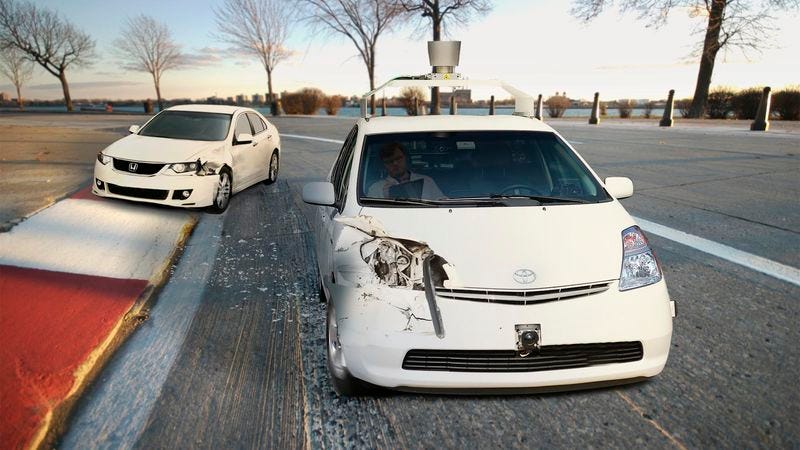
Describing the prototype as a major technological breakthrough for autonomous vehicles, engineers at Toyota in Plano, Texas, unveiled the first driverless car Thursday. This car has a very special ability in that it is capable of committing a hit-and-run.

Members of the design team told reporters that the innovative autonomous car, which relies on a system of sensors and sophisticated algorithms to provide it with a split-second reaction after being involved in a collision, has successfully demonstrated the capacity to immediately flee the scene of an accident to avoid legal repercussions without any human intervention.

“With this step forward, we are closer than ever to having road-ready self-driving cars that are proficient at assessing vehicular damage, analyzing surroundings, and performing complex maneuvers to effectively dodge responsibility after clipping another automobile,” said head engineer Stephen Graham, adding that throughout numerous crash tests on a closed course, the driverless car perfectly executed evasive actions to frantically peel away before observers could record the license plate number. “Very soon, there could be a fleet of self-driving cars specifically designed to eliminate the possibility of human error when making a break for it following a fender bender.”

My thoughts: This could be a huge step forward for car makers, but it also puts Toyota in the forefront in what could be a newly booming business in the lackluster and suffering car industry. The future is now, folks.


Article Here:

https://www.theonion.com/engineers-unveil-new-driverless-car-capable-of-committi-1819577657


Cracks found days before the Collapse of the Florida Bridge

Discovery of Cracks in Florida Bridge before Collapse
By: Dasanie Pena

    At the Florida International University in Miami, FL, the pedestrian bridge collapsed killing about 6 people. Days before the collapse, it is reported that the engineers had discovered cracks within the bridge. This brings about questions about the possibility of preventing the collapse and saving the lives lost. This bridge was constructed with a single truss within the middle of the bridge and support on the bottom of the bridge.
    There was a extremely important report from the lead engineer of the firm concerning the design of the bridge. They reported that a voicemail was left for a Florida Department of Transportation employee stating there have been discoveries of cracks in the bridge. However, the employee that was sent the voicemail was out of the office. The voicemail wasn't received by the employee till Friday. That was the day after the collapse. Yet the message to the employee stated that the crack which spanned cross the north side of the bridge but it wasn't considered to be safety concern.

“We’ve taken a look at it and, uh, obviously some repairs or whatever will have to be done, but from a safety perspective we don’t see that there’s any issue there so we’re not concerned about it from that perspective,” said the engineer, W. Denney Pate. “Although obviously the cracking is not good and something’s going to have to be, you know, done to repair that.”

    The transportation department said on Friday that “the responsibility to identify and address life-safety issues and properly communicate them is the sole responsibility of the F.I.U. design-build team,” referring to Florida International University, which commissioned the bridge.
 On Friday, the search for survivors was called off and the attention was turned to the reasoning why the bridge failed. The bridge was worth 14 million dollars and was built at what is called “accelerated construction”. Instead of closing off roads in order to build the bridge, pieces of the bridge were built off site and brought over. Building a bridge at accelerated construction does not change the safety factor of the bridge. Yet the transportation of the pieces causes stress to different pieces of the bridge. It was also stated that all people involved in the process and design of the bridge were all from very influential firms.

https://www.nytimes.com/2018/03/16/us/florida-bridge-cracks.html?rref=collection%2Ftimestopic%2FEngineering%20and%20Engineers&action=click&contentCollection=science&region=stream&module=stream_unit&version=latest&contentPlacement=2&pgtype=collection


Noise cancelling device halves noise pollution through open windows

Alex Newton

Engineering

May 18 2018


Nanyang Technological University developed a device that can reduce noise pollution entering the buildings. This device works even when the windows are open. The device reduces up to 50% of the noises coming from nearby areas. This is similar to noise canceling headphones and uses the same technology. Its able to release a counter sound to fight those noisy sound waves.


Noise cancelling device by NTU scientists halves noise pollution through open windows

Wednesday, May 2, 2018

Deadly Gas


               Air pollution poses a massive threat to the public and is an issue that needs to be dealt with when it arises or many people could become sick or even die. This is exactly what happened in France in 1952 where over 150,000 people went to the hospital and 4,000 people died from what was eventually dubbed, The Great Smog.
               Scientists are looking for disease caused by particles often way too small to see with the human eye. These particles come from many sources such as power plants, factories, homes and cars, and even forest fires. If a person breathes in these particles they can move deep into your lungs where they can enter your bloodstream. The blood can carry these particles anywhere in your body even your brain and they trigger inflammation anywhere they go. This is why making sure the air is clean is such a huge problem because it only takes a small amount of particles to harm our bodies. High traffic roads are a very prominent source of pollution. Research has shown that people who live near areas with a lot of traffic related air pollution are much more likely to get Alzheimers Disease than people who do not.
               Air pollution is a massive threat to public safety and if it is not quickly noticed it can lead to the sickness and death of many people which is why it is such a big problem.

Link:https://www.sciencenewsforstudents.org/article/dirty-air-can-harm-your-brain-and-stress-body

Microphone for light: Tiny guitar string vibrates 1 billion times when plucked

Scientists have engineered a tiny guitar string that vibrates 1 billion times when plucked to use as a microphone for light.

Listening to light


Strain can be used to engineer unusual properties at the nanoscale. Researchers in Tobias Kippenberg's lab at EPFL have harnessed this effect to engineer an extremely low loss nanostring. When plucked, the string vibrates for minutes with a period of a microsecond (equivalent to a standard guitar note playing for a month). Using it as an ultrasensitive microphone, the researchers hope to be able to "hear" the sound of photons in a laser beam.


Because of their small mass, nanostrings, like the ones developed in the Kippenberg lab, are expected to have an important impact on traditional sensing applications. For example, they are capable of detecting attonewtons (1 attonewton = 1.0 × 10-18 newton), which could detect the gravitational pull between human beings.
https://www.sciencedaily.com/releases/2018/04/180412141008.htm